I stole this highly bloggable video from HRO, but I think it's worth a second analysis driven by an ironism with a different number of repetitions of the word "post" in front of it (this is a de facto admission that my blog is now nothing more than a reblog of HRO, and certainly not the most successful one at that - see HRO Exegesis). Charles writes:
I haven’t ever really listened to the Presets too indepth, except for this one Lifelike remix of them. But I have heard that they are ‘amazing’ live, and they probs are. N e ways, this music video is pretty meaningful bc it was directed by the same person who made M83’s “Kim and Jessie.” I think I can really identify with this music video because I am a teen from the suburbs who wants to go to the city and ‘get my dance on’ but then also get meaningful at a beach bonfire. <3>
Okay. But also: I think I can really identify with this music video because I am a "young adult" from a city nostalgic for a suburban experience that I didn't have. I want to go to the Hollywood walk of fame and "get my dance on" as if I were a t(w)een from the suburbs. What's authentic about this video is that is evokes a nostalgic longing for an experience of urban life as something aesthetically supple, something new and forcefully alienating and beautiful. The first shot of a sped-up LA freeway scene (0:30), interspersed with our tween walking to school in his uniform, is infused, if not with the wide-eyed, naive awe of a suburbanite's first view of the big, godless city, then with his first wonderous view of a TV commercial for a global investment bank with calm professionals presiding over the chaotic urban scene outside of their gleaming office tower. Though it's not particularly interesting to point out that this shot is "cliche" (here we go again), the aesthetic power of the shot is due more to an evocation of the form which we might imagine a suburban longing for the dissolution of subjectivity offered by the anonymous metropolis, cars whizzing past, would take. Indeed, we don't ever have to "imagine" what form it would take, because the desire itself is cultivated by, e.g., these advertisements (and more forcefully, Hollywood film - it is not insignificant that this is L.A. and not New York).
The shot is thus all the more powerful because we've seen it before. The desire being evoked here is not our desire for "that (postmodern) urban experience"; rather, it is a nostalgia for that desire. This also extends to the way the video treats a notion of "Hollywood culture." As our tween sashays down the Walk of Fame, bowling over Elvis and Marilyn Monroe, there is a gleeful kind of irony which, precisely because it is not "post-" (or rather, because it is "post-post-"), feels naive. Wouldn't it be nice to just genuinely ironically enjoy pop culture, instead of having to try to ironically enjoy it? This need to try (Baudelaire's "heroic" affirmation of the present in all its squalid glory), and the effort to navigate the neverending series of quotation marks it unleashes, is a trope to which the French are especially (uniquely?) well-suited.
The French director of this video, Eva Husson, also directed a video for M83. Though I think the unheimlich humor of the M83 video is slightly tangential in regards to this aesthetic, M83 is perhaps the best example of the contemporary Baudelairean attempt to confront postmodernism. Is it a surprise that M83 is French as well?
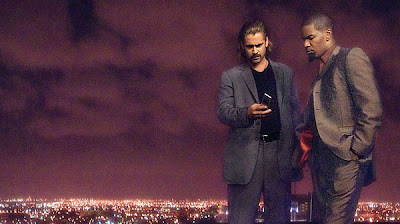
These could be shots from the Presets video. On the one hand, blissful, "authentic" suburban tween life; on the other, the promise of the Real of urban anonymity and amorality. And again, with the suburban scene, it is the highway in the background which makes the photograph particularly moving; rather than a pure bucolic/rural - and thus historically "previous" to the urban - ideal, it evokes a knowing naivete and willfully heroizes precisely the ironic/knowing aspect. With the urban scene, this is again a generic shot, and what's important about it is the intentionally pseudo-authentic details (grainy stock, saturated colors). Note the similarity to shots from Heat, Miami Vice, and Roadtrip 2K8:
WHAT IT'S LIKE TO DATE A HOTSHOT COSMOPOLITAN JULY 2006 BY JULIA ALLISON
Congressmen in Washington are like movie stars in Hollywood. They’re everywhere, they’re always shorter in person – and yet, everyone is still totally impressed.
As a government major at Georgetown, I was a shameless political groupie. I tracked the rarest of species in our nation’s capitol – the young, unmarried, good-looking politician. Actually, I only found one. The year before, he was one of People’s 50 Most Beautiful People. Like a teenager with a crush on Brad Pitt, I taped the photo to my desk, where it stayed (embarrassingly) for 8 months.
Of course, I never expected to actually meet him.
But one evening, out to dinner, I spied him at the table next to mine and courageously introduced myself. I was 21; he was turning 32 that evening. A junior in college, I had never dated a guy older than 24, let alone one with such a formidable resume: Ivy League school, law degree, a prestigious political family, and – oh yeah – an office on Capitol Hill with 20 staff members.
I didn’t realize it then, but I had already fallen into the insidious “he’s better than me” trap – by putting him on a pedestal, I was unconsciously telling myself that I wasn’t worthy. In the coming months I would realize how misguided this mindset was.
Our five-minute intro turned into an entire evening of flirting as he invited me along with as he celebrated his birthday. We went from the restaurant to a swanky hotel bar, where he asked for a birthday kiss – and I practically fainted from excitement.
When he said goodnight late that evening, it never occurred to me he would call again. But I was wrong; he called the next week, and the week after.
In retrospect, I’m not sure why I was so surprised – as the dating columnist for The Georgetown Hoya, I knew a thing or two on how to keep a man’s interest. Or at least, a college guy’s interest! But one of the most eligible bachelors in DC? I really believed I was in over my head.
The concept of him being interested in me was so shocking that my normally healthy self-esteem couldn’t get to my brain!
Unnerved by talking with him on the phone, I would prepare little “cheat sheets” so I wouldn’t blank on conversation topics. (Who does that??) I would compare myself constantly to him: He makes six figures, I get an allowance. He meets with world leaders, I stopped by my professor’s office yesterday.
Again and again, I fell short in my own mind. Of course, I’m not the only woman to find herself involved with a man who she views – either consciously or unconsciously – as “superior” to herself. He doesn’t have to be a movie star; I’ve watched beautiful, confident girls reduced to awkward, desperate messes wondering why their boyfriends – the star of the basketball team or a rich doctor or anyone else who generally intimidates them – would ever want them.
I was pretty far along that road when he asked me on a weekend ski vacation. I lost five pounds, bought a new pink ski suit and compulsively planned out every outfit. Then we got there – and … he couldn’t ski. Not sort of couldn’t ski, but god awful, I-hope-he-doesn’t-break-his-leg couldn’t ski.
Out there on the slopes, he wasn’t a hotshot politician, he was just a guy. A guy with no coordination. Later, watching C-Span together (although I’d really rather watch Oprah), he got the Kuwaiti ambassador’s name wrong – and I corrected him! Suddenly, I began to see beyond the image to the real person, who wasn’t so intimidating after all.
And when I took the big man OFF campus, I realized that I … well, I just wasn’t that into him. Sure, it was an ego boost to date a prominent A-Lister. But beyond that, we didn’t have much in common.
The irony didn’t escape me. All this time I had been building him up in my mind and underestimating my own qualities, forgetting that no one can be in a good relationship with an idol – it has to be equal. And if you don’t have self-respect, how can he respect you?
The whole thing made me laugh. After all, I had asked myself so many times, “Why does he want to be with me?” when I should have been asking “Why do I want to be with him?”
Baudelaire wrote that director Michael Mann (Heat, Collateral, The Insider) is "looking for that quality which you must allow me to call 'modernity'...he makes it his business to extract from fashion whatever elemental it may contain of poetry within history, to distill the eternal from the transitory." Modernity, as Baudelaire defines it, is "the ephemeral, the fleeting, the contingent."
For those of us looking for the modern-day Ulysses, such as Pitchfork Music, postmodern (i.e., for our purposes, sufficiently contemporary and socially critical) art has to have some sort of sad irony about it, some supposedly fractured Wasteland-esque evocation of the poverty and inanity of mass culture. Even films such as Tarantino's, I think, essentially imply this type of critique: by trying to create "real"-seeming, vibrant characters whose behavior is an agglomeration of cliches from other films, he suggests that reality is now simply mimed, a simulacrum, andthat we cannot have even moving films but only ironic inanity.
Michael Mann - Baudelaire's "Painter of Modern Life" - is someone that these ostensibly cultured and critical hipsters might look down upon. The plot in Miami Vice is not only cliche, it doesn't know it's cliche; it's not only violent, it expects the violence to be frightening and moving. Yet who's to say that Tarantino actually knows how cliche he's being? The presumption of a position from which one can perform the ironic critique with pure remove is the same bird-lipped modernist elitism that people like Tarantino are trying to get away from.
Does anyone really not find modern life - let's call it "late capitalism" for fun - to be almost sublime? If you're not a Luddite - actually, even if you are - can you deny that there is something intoxicating about mass culture, about huge, technologized cities populated with complacent receptacles of ideology, about millions of people on treadmills across the world, listening to techno on their iPods and dreaming their little dreams?
In Miami Vice, we get an evocation of all that is terrifying and beautiful about late capitalism: shiny white cars lost in the crowd on the freeway; slick, mindless dudes talking on their cell phones; sexed out $lutz in glittery bodysuits writhing at "velvet-rope" clubs, "go-fast" boats zipping along an overdeveloped coastline. Globalization (international drug trade, Chinese-Cuban businesswoman as the post-feminist embodiment of the 'Protestant Work Ethic', the faux-internationalism of Miami) figures large; mass culture is treated simply as it is and evoked straightforwardly. The film lets it speak for itself, and it is unbearably moving. The tendency to dismiss films like these as cheesy is, I think, an indication of the fact that people are uncomfortable with the position it puts them in. Take a look at this trailer:
or this admirable home-made thing:.
I don't want to hear that the Linkin Park/Jay-Z mash-up is "bad." When Jay-Z drops the line "Boeing jets" while the teaser cuts to a drug-running plane, then cuts back to the club scene, then to Colin Ferril pulling a 360 in the Ferrari, then to Colin Ferril and Gong Li making out in a limo - which looks like a sort of sublime, frenetic business transaction - this is the beauty of late capitalism. The suffocating literalness of the trailer - matching Jay-Z's raps with 'related' scenes ("blow you to smithereens" gets played over a car getting blown up) and the beat to intercut shots of Colin Ferril and Jamie Foxx cocking various guns - brings us even closer to the text. As in Wagner's use of leitmotifs in derRing des Nibelungen, the film aestheticizes itself through a synthesis of the aural and visual (creating a "kinetic" feel) and thus the viewer is forced to experience it more intimately and fully. It's not just a song playing over images from the movie, which happens to enhance the mood of the film, but rather the two fuse and come to work "directly on the emotions" - and yet, of course, it's anything but direct; it's wholly mediated through the trappings of late capitalist-gemeinschaft/gesellschaft. This "mediated authenticity" is the exactly the sublime element of late capitalism; what's so fun about hitting the club with your bros is that when you're dancing to Soulja boy with some hottie, it feels real, yet it also feels rediculous and false (like those fake titties! HIGH FIVE BRO!!!!!!!). This is the pleasure of Krakauer's "mass ornament," the aesthetics of the mechanization of human life, here taken to its logical late-capitalist conclusion with the mechanization of culture as such. Miami Vice "works on us"; it leaves little space for the comfortably ironic transcendental liberal subject. Therein lies its beauty and, indeed, its political possibility
Thus, I think it is reasonable to say that Miami Vice exists in the space of the contemporary gesamkunstwerk.